.png)
The Osage Nation

The Osage Nation at a Glance
Tribe Name: Osage Nation (Wahzhazhe). Wahzhazhe translates to "Children of the Middle Waters," reflecting their ancestral roots along major river systems in the American Midwest.
Language: Osage (Wazhazhe ie).
Language Tree: Siouan (Dhegiha Siouan branch).
Direct Relatives: The Osage share close linguistic, cultural, and historical ties with the Kaw (Kansa), Omaha, Ponca, and Quapaw nations.
Enrollment: Over 24,000 enrolled citizens.
Land Ownership: Encompassing all of Osage County in northeastern Oklahoma, the reservation spans approximately 1.47 million acres (2,300 square miles), with the tribe retaining collective ownership of the underground Osage Mineral Estate.
Sources: Osage Nation Government; Osage Tribal Museum; Oklahoma Historical Society; Bureau of Indian Affairs.
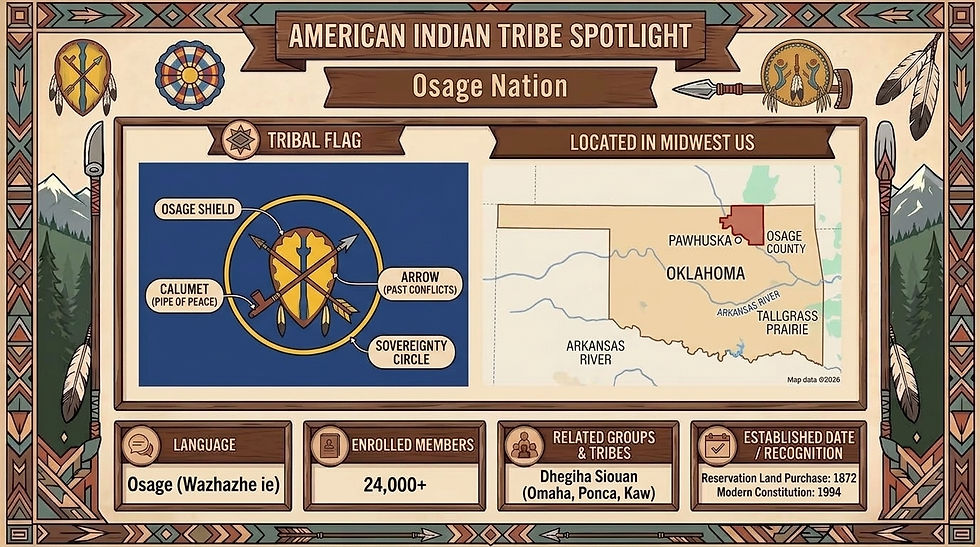
Feel free to right click, download, and share this graphic!
Brief History The history of the Osage Nation is rooted in the fertile river valleys of the Ohio and Mississippi basins, later expanding across vast territories encompassing present-day Missouri, Kansas, Arkansas, and Oklahoma. As a formidable woodland and plains power, the Osage controlled extensive trade networks and hunting grounds, rapidly adapting to equestrian life in the 18th century. Through strategic diplomacy and skilled commerce, they maintained dominance across the Midwest while trading with early European explorers.
The 19th century brought forced land cessions as Euro-American settlement pressed westward. After surrendering millions of acres in Missouri and Kansas, Osage leadership made a landmark decision in 1872: rather than accepting a federally mandated reservation, they used proceeds from Kansas land sales to purchase their own reservation in Indian Territory (modern-day Oklahoma). This purchase granted them legal title to their land, creating a uniquely sovereign foundation.
When federal allotment laws attempted to dismantle tribal land bases in the early 20th century, Osage leaders negotiated the Osage Allotment Act of 1906, ensuring the subsurface mineral rights were held collectively by the nation. The discovery of immense petroleum reserves beneath their reservation in the 1920s generated unprecedented wealth distributed via tribal headrights. Despite facing systemic guardianship exploitation and the horrific "Reign of Terror" murders by outside opportunists, the Osage preserved their mineral reservation and established a modernized tripartite constitutional government in Pawhuska, Oklahoma.

Ancient Echoes: The Spirit of the Osage The philosophical center of Osage culture revolves around Wakonda (the Great Mystery or Creator) and the balance of physical and spiritual forces in the universe. Traditional Osage society was organized into two primary moieties: the Sky (Tzi-sho) and the Earth (Ts-zhu). This dual structure influenced everything from clan identity and camp arrangements to council leadership, ensuring that decisions reflected harmony between heavenly and earthly realms.
The Osage are renowned for distinctive visual and ceremonial arts. Master textile artists created intricate ribbonwork—folding and layering silk ribbons onto blankets and traditional garments in complex geometric patterns. Every June, the nation gathers for the In-Lon-Schka ceremonial dances, where sacred songs, drum keeper traditions, and clan honors reinforce spiritual wellness, community unity, and respect across generations.
Modern Horizons: Sovereignty & Sustainability Today, the Osage Nation operates a robust tripartite government structure featuring executive, legislative, and judicial branches that oversee health, education, housing, and environmental protection. Prioritizing community health and food sovereignty, the nation established the Wahzhazhe Health Center, an agricultural ranch, and a tribal meat processing facility to provide locally sourced food security to tribal citizens.
Cultural and language revitalization remain central to the nation's future. Through the Osage Nation Language Department, immersion schools like the Wahzhazhe Always Academy, mobile learning tools, and an official written orthography, the tribe is actively restoring Wazhazhe ie to daily community life. By combining traditional stewardship with economic innovation, the Osage Nation continues to assert its sovereign strength and cultural legacy.

Tribal Land & Homelands The historical land base of the Osage Nation was defined by major geographical regions across the central North American waterways:
East (Ohio River Basin): Ancestral woodland origins prior to 17th-century westward migration.
North (Missouri River Valley): Primary village locations, agricultural hubs, and trading territory across southern Missouri and Kansas.
West (Flint Hills Tallgrass Prairie): Sacred hunting grounds utilized for seasonal bison hunts and plant harvesting.
South (Ozark Plateau & Arkansas River Basin): Mountainous homelands providing natural shelter, mineral deposits, and sacred river corridors.
Covering the entirety of Osage County, Oklahoma (1.47 million acres), the modern reservation is organized into primary cultural and administrative districts, including Pawhuska, Hominy, and Gray Horse. Tribal properties are managed by the Osage Nation Department of Natural Resources and the Osage Minerals Council, protecting the mineral reservation, natural reserves, and tribal parks surrounding Bluestem Lake.
Learn More & Resources
Osage Nation Official Government Portal: osagenation-nsn.gov
Osage Tribal Museum (Oldest Tribal Museum in the U.S.): Pawhuska, Oklahoma
Osage Cultural Center & Language Department: osagenation-nsn.gov/culture
Osage Minerals Council: osageminerals.org
Wahzhazhe Health Center: Pawhuska, Oklahoma
References & Sources
Osage Nation Government. Constitution of the Osage Nation & Osage Allotment Act of 1906. Pawhuska, OK.
Burns, Louis F. A History of the Osage People. University of Alabama Press.
Osage Tribal Museum & Archives. Historical Records and Oral Histories of the Wahzhazhe People.
U.S. Bureau of Indian Affairs. Osage Agency Land Title and Mineral Reservation Records.
Oklahoma Historical Society. Osage County and Tribal Nation Historical Papers.


Comments