
The Menominee Nation (Mamaceqtaw)

The Menominee Nation at a Glance
Tribe Name: Menominee Indian Tribe of Wisconsin (Mamaceqtaw / Omaeqnomenewak). Mamaceqtaw translates to "The Ancient Ones" or "The Moving People," reflecting their status as the region’s original inhabitants. Omaeqnomenewak translates to "People of the Wild Rice," honoring the sacred grain central to their culture and lifeways.
Language: Menominee (Omāēqnomenēweqnēwan).
Language Tree: Algonquian (Central Algonquian branch).
Direct Relatives: As historic inhabitants of the Western Great Lakes, the Menominee share close linguistic, cultural, and political ties with neighboring Algonquian nations—including the Ojibwe (Chippewa), Odawa, Potawatomi, and Stockbridge-Munsee—as well as the Siouan-speaking Ho-Chunk Nation.
Enrollment: Over 8,700 enrolled tribal citizens.
Land Ownership: The modern Menominee Reservation spans approximately 235,523 acres (about 358 square miles), encompassing the entirety of Menominee County, Wisconsin, and portions of northern Shawano County, with tribal government headquarters situated in Keshena, Wisconsin, along the Wolf River.
Sources: Menominee Indian Tribe of Wisconsin Government; College of Menominee Nation; U.S. Bureau of Indian Affairs; Library of Congress (Public Law 93-197).

Brief History
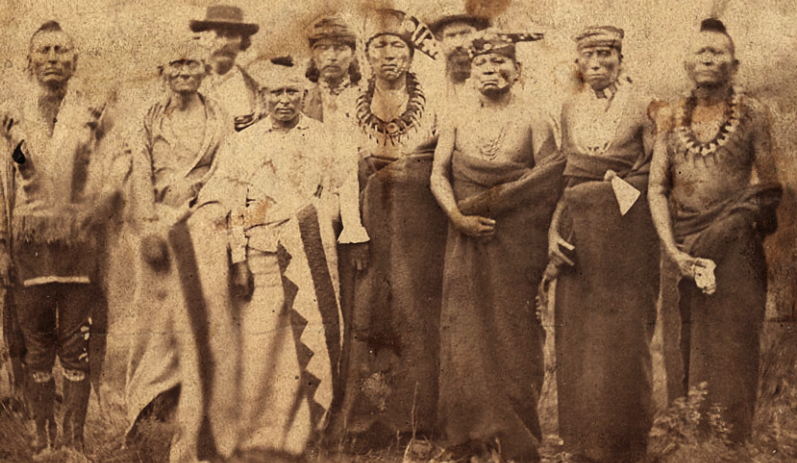
The history of the Menominee Nation is an extraordinary narrative of cultural endurance, deep ecological wisdom, and an unwavering defense of homeland sovereignty. Archaeological evidence and oral traditions confirm that the Menominee are Wisconsin's oldest continuous human inhabitants, having stewarded the rivers, lakes, and mixed hardwood forests of the region for more than 10,000 years. Their ancestral territory once encompassed more than 10 million acres across present-day Wisconsin and the Upper Peninsula of Michigan.
The 19th century brought intense colonial pressure from Euro-American lumber interests and federal removal policies. While federal authorities attempted to force the nation west of the Mississippi River to Minnesota under the proposed Treaty of Lake Poygan (1848), Menominee leaders led by Chief Oshkosh firmly refused to abandon their ancestral home. Demonstrating exceptional diplomatic resolve, Chief Oshkosh inspected the proposed Minnesota lands, declared them unsuitable for his people, and negotiated the Treaty of the Wolf River (1854), securing a permanent, sovereign reservation along the upper Wolf River.
In the mid-20th century, the Menominee faced an existential threat under the federal "Termination" era. Through House Concurrent Resolution 108 and the Menominee Termination Act of 1954 (Public Law 83-399), Congress abruptly stripped the tribe of federal recognition, terminated trust protections, and converted the reservation into Menominee County—Wisconsin's poorest county. The loss of federal programs closed the tribal hospital, crippled basic municipal infrastructure, and imposed severe taxation on tribal lands.
Rather than surrender their political identity, Menominee citizens organized a historic resistance movement. In 1970, community leaders and grassroots activists led by Ada Deer formed DRUMS (Determination of Rights and Unity for Menominee Shareholders). Waging a disciplined grassroots legal, legislative, and public education campaign in Washington and across Wisconsin, DRUMS achieved a landmark victory: on December 22, 1973, President Richard Nixon signed the Menominee Restoration Act (Public Law 93-197). This legislation repealed termination, restored federal recognition and trust protections, and fundamentally reshaped federal Indian law by inaugurating the modern era of tribal self-determination across North America.

Ancient Echoes: The Spirit of the Mamaceqtaw
The spiritual and philosophical foundation of Menominee society revolves around profound reverence for Māēh-Awētok (the Great Spirit) and maintaining balance with the natural world. Creation teachings trace the origin of the people to the mouth of the Menominee River, near Green Bay. There, the Great Ancestral Bear (Awāēhsaeh) emerged from the earth and was transformed into human form, joined by the Eagle (Ka-kew), Wolf (Mah-wāēh), Crane (Otā-tshiah), and Moose (Mū-suw). These sacred ancestral beings established the five primary clans (doodemag), which historically structured community governance, kinship, ritual responsibilities, and ecological caretaking.
Central to Menominee identity is manoomin (wild rice), considered a divine gift. Harvested in early autumn from traditional canoes using cedar knockers (bawa'iganaakoog), wild rice represents more than physical nourishment; it is an enduring symbol of spiritual reciprocity, patience, and community connection.
Visual and ceremonial arts remain vital expressions of Menominee identity. Master artisans pass down generations of intricate black ash splint basketry, porcupine quill embroidery on birchbark, woodland floral beadwork, and finger-woven yarn sashes. Every summer, the community gathers at the Woodland Bowl in Keshena for the annual Menominee Contest Powwow, where drum groups, ceremonial dancers, and elders celebrate resilience, honor veterans and ancestors, and pass living knowledge to younger generations.
Modern Horizons: Sovereignty & Sustainability
Today, the Menominee Indian Tribe of Wisconsin operates a tripartite constitutional government featuring Executive and Legislative authority vested in the nine-member Menominee Tribal Legislature, alongside an independent Tribal Judiciary (Trial Court and Supreme Court). The tribal government oversees comprehensive public programs, including healthcare, elder housing, education, natural resource conservation, and tribal law enforcement.
Environmental stewardship remains the crown jewel of Menominee sovereignty. The tribe's commercial forestry enterprise, Menominee Tribal Enterprises (MTE), is internationally recognized as a premier global model of sustainable silviculture. Guided by Chief Oshkosh's timeless directive—"Start with the rising sun and work toward the setting sun, but take only the mature, diseased, or fallen trees, and the forest will last forever"—the tribe has harvested more than 2.3 billion board feet of timber over the past 150 years. Remarkably, the forest today contains more standing timber volume and older, larger trees than when commercial harvesting began in 1854. The lush 220,000-acre canopy forms a sharp, distinct green boundary that is clearly visible from orbiting satellites against Wisconsin's cleared agricultural lands.
In higher education and community development, the tribe chartered the College of Menominee Nation (CMN) in 1993. An accredited 1994 Land-Grant institution, CMN offers degree programs rooted in Menominee culture and sustainable community development through its Sustainable Development Institute (SDI). Alongside healthcare services provided by the Menominee Tribal Clinic, aggressive language revitalization initiatives—including immersion classrooms, digital learning resources, and master-apprentice partnerships—are actively restoring Omāēqnomenēweqnēwan to daily community life.
Tribal Land & Homelands
The historical homelands of the Menominee Nation spanned the diverse waterways and mixed boreal-hardwood forests of the western Great Lakes basin:
East (Green Bay & Lake Michigan Shoreline): Ancient coastal fishing grounds, extensive wild rice estuaries, and vital maritime trade routes connecting to neighboring Great Lakes nations.
North (Menominee River Headwaters & Upper Peninsula): Dense pine and hardwood forests, maple sugarbushes, winter hunting grounds, and the sacred river mouth of tribal creation.
West (Wolf River Basin & Central Wisconsin Plains): Rushing river rapids, ancient sturgeon habitats, and the core forested sanctuary of the modern reservation.
South (Fox River Valley & Lake Winnebago): Southern river valleys providing fertile soils for seasonal camps, agricultural gardens, and shared regional council grounds.

Learn More & Resources
Menominee Indian Tribe of Wisconsin Official Government Portal: menominee-nsn.gov
College of Menominee Nation: menominee.edu
Menominee Tribal Enterprises (Sustainable Forestry): mtewood.com
Menominee Historic Preservation Department & Cultural Museum: Keshena, Wisconsin
Menominee Tribal Clinic & Wellness Center: Keshena, Wisconsin
References & Sources
Menominee Indian Tribe of Wisconsin. Constitution and Bylaws of the Menominee Indian Tribe of Wisconsin. Keshena, WI.
United States Congress. Public Law 93-197: Menominee Restoration Act (87 Stat. 770). Washington, D.C.
United States. Treaty of the Wolf River with the Menominee (1854), 10 Stat. 1064.
Deer, Ada, and Theda Perdue. Making a Difference: My Fight for Native Rights and Social Justice. University of Oklahoma Press.
Davis, Thomas. Sustaining the Forest, the People, and the Spirit: The Story of the Menominee People and Their Forest. State University of New York Press.
Keesing, Felix M. The Menomini Indians of Wisconsin: A Study of Three Centuries of Cultural Contact and Change. American Philosophical Society.


Comments