.png)
The Diné Nation

The Diné Nation at a Glance
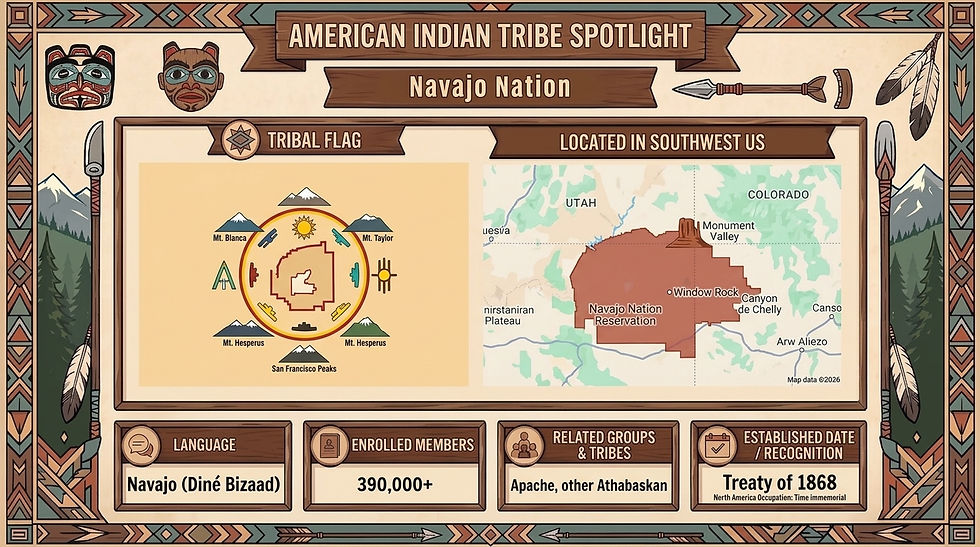
Tribe Name: Diné (Navajo Nation). Diné translates to "The People," reflecting their deep ancestral identity tied to Dinetah, their sacred homeland bounded by four sacred mountains in the Southwest.
Language: Diné Bizaad.
Language Tree: Na-Dene (Southern Athabaskan / Apachean branch).
Direct Relatives: The Diné share linguistic and ancestral roots with Apache nations as well as Northern Athabaskan peoples of interior Alaska and Northwestern Canada.
Enrollment: The Navajo Nation is the largest federally recognized tribe in the United States, with over 390,000 enrolled citizens.
Land Ownership: Spanning over 27,000 square miles across Arizona, New Mexico, and Utah (the Four Corners region), the Navajo Nation Reservation is the largest contiguous land area held by an Indigenous tribe in the United States.
Sources: Navajo Nation Government; Navajo Nation Museum; Diné College; Bureau of Indian Affairs.
Brief History
The history of the Diné is rooted in the high desert plateaus, red-rock canyons, and sacred mountains of the American Southwest. Emerging into Dinetah—their ancestral homeland bounded by Mount Hesperus, Mount Blanca, Mount Taylor, and San Francisco Peaks—the Diné adapted to the semi-arid landscape through hunting, gathering, and early agriculture. Following contact with neighboring Puebloan peoples and Spanish colonizers, the Diné adopted sheep herding, pastoral farming, weaving, and silversmithing, building a thriving desert economy tied to seasonal migration and ecological stewardship.
The 19th century brought severe conflict as Euro-American settlement expanded westward. In 1864, following scorched-earth military campaigns led by the U.S. government, over 10,000 Diné were forcibly marched more than 300 miles from their homeland to Fort Sumner, New Mexico—a tragic forced relocation known as the Long Walk (Hwéeldi). Hundreds died from disease, starvation, and harsh conditions during captivity. In 1868, Diné leaders negotiated the landmark Treaty of Bosque Redondo, securing their legal sovereignty and returning home to rebuild their nation on ancestral soil.
Throughout the 20th century, the Diné played a critical role in global history, most notably through the Navajo Code Talkers, whose uncrackable military code based on Diné Bizaad proved vital to Allied victory during World War II. Despite economic challenges and long battles over resource extraction and water rights, the Navajo Nation established a centralized three-branch tribal government headquartered in Window Rock, Arizona, continually asserting political self-determination and regional authority.
Ancient Echoes: The Spirit of the Diné
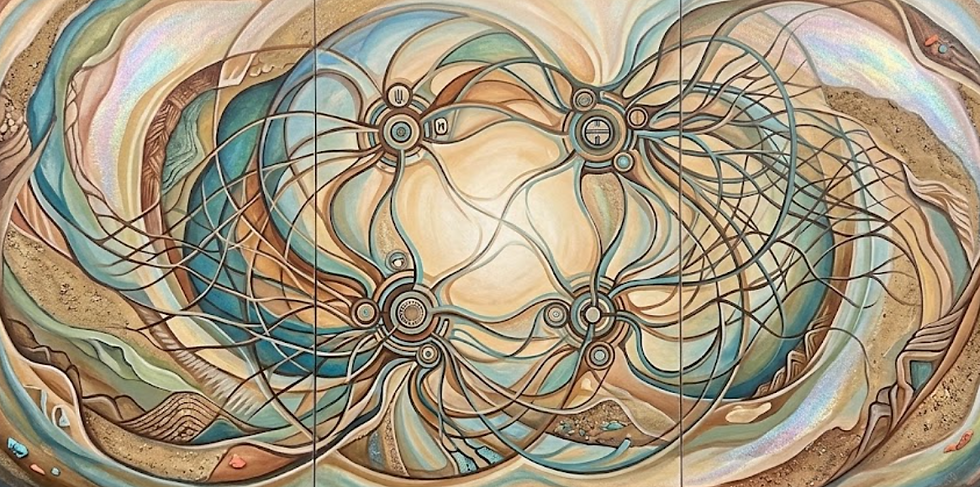
The philosophical foundation of Diné culture is Hózhǫ́—a holistic concept encapsulating harmony, balance, beauty, and wellness with the natural universe. Diné society is built upon a matrilineal kinship system (K'é), comprising over 100 clans. An individual identifies through four primary clans—their mother’s clan, father’s clan, maternal grandfather’s clan, and paternal grandfather’s clan—creating an interconnected network of respect, identity, and community duty across the nation.
The Diné are world-renowned for their artistic and spiritual traditions. Intricate wool tapestries woven on upright wooden looms record complex sacred geometries and seasonal shifts. Silversmiths and stone carvers craft iconic silver and turquoise jewelry that serves as both artistic expression and generational wealth. Sacred healing ceremonies (Hózhǫ́ǫ́ǰí / Nightway) led by medicine men (Hataałii) incorporate chanting, sacred songs, and temporary dry-paintings (sandpaintings) created with natural pigments to restore spiritual balance to individuals and the land.
Modern Horizons: Sovereignty & Sustainability
Today, the Navajo Nation operates the largest tribal government infrastructure in the United States, managing health, education, law enforcement, and natural resources across three state jurisdictions. Through institutions like Diné College—the first tribally controlled college in the U.S., founded in 1968—the nation prioritizes higher education rooted in traditional philosophy (Sa'ah Naaghaí Bik'eh Hózhóón). Modern leaders actively work to transition the regional economy toward renewable solar energy, sustainable ranching, and agricultural sovereignty.
At the same time, aggressive language and cultural preservation efforts are active across the reservation. Dual-language immersion programs, digital apps, and youth academies actively work to increase fluency in Diné Bizaad. By pairing traditional ecological knowledge with contemporary legal and political innovation, the Navajo Nation remains an enduring symbol of Indigenous strength and cultural vitality in North America.
Tribal Land & Homelands
The ancestral land base of the Navajo Nation (Dinetah) is geographically defined by four primary Sacred Mountains that mark its traditional boundaries:
East (Ha’a’aah): Sis Naajiní (Blanca Peak, Colorado) – Represented by white shell and dawn.
South (Shádi’ááh): Tsoodził (Mount Taylor, New Mexico) – Represented by turquoise and daylight.
West (E’e’aah): Dook’o’oosłííd (San Francisco Peaks, Arizona) – Represented by yellow abalone shell and sunset.
North (Náhookǫs): Dibé Ntsaa (Mount Hesperus, Colorado) – Represented by jet black stone and night.
Covering more than 17.5 million acres (27,000 square miles), the modern reservation spans across 110 local administrative subdivisions called Chapters, organized into five regional agencies: Chinle, Eastern Navajo, Fort Defiance, Shiprock, and Western Navajo. Tribal lands are managed by the Navajo Nation Division of Natural Resources and Navajo Land Department, overseeing a complex mosaic of tribal trust land, individual allotments, and protected monuments such as Canyon de Chelly and Monument Valley Navajo Tribal Park.

Learn More & Resources
Navajo Nation Official Government Portal: navajo-nsn.gov
Navajo Nation Parks & Recreation: navajoparks.org
Diné College (Higher Education & Cultural Studies): dinecollege.edu
Navajo Technical University: navajotech.edu
Navajo Nation Museum & Historical Department: Window Rock, Arizona
References & Sources
Navajo Nation Government. Treaty Between the United States of America and the Navajo Tribe of Indians (Treaty of Bosque Redondo), 1868.
Diné College Press. Diné History and Culture: Philosophy of Sa'ah Naaghaí Bik'eh Hózhóón. Tsaile, AZ.
Navajo Land Department. Land Status and Chapter Boundary Records. Window Rock, AZ: Division of Natural Resources.
U.S. Bureau of Indian Affairs. Navajo Regional Office Land & Enrollment Statistics.
Iverson, Peter. Diné: A History of the Navajos. University of New Mexico Press.


Comments