.png)
Yarrow

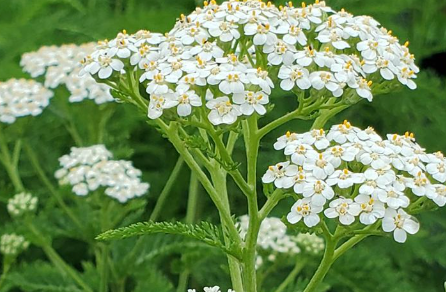
Botanical Identification
Common Names: Yarrow, Common Yarrow, Milfoil, Thousand-leaf, Waabano-washk (Anishinaabemowin - "Eastern Medicine"), Ajidamoowaanow (Anishinaabemowin - "Squirrel Tail"). Latin Name: Achillea millefolium. Plant Species: Achillea belongs to the aster family (Asteraceae). Known Habitat: Yarrow is incredibly adaptable and widespread across North America, particularly thriving in the Great Lakes, Plains, and Woodland regions. It is commonly found in open meadows, prairies, pastures, and along sunny, disturbed forest edges. It prefers well-drained soil and full sun.
How to Correctly Identify Yarrow
Identifying Yarrow requires careful attention to its distinct leaves and flower clusters, especially since it shares a habitat with several dangerous lookalikes.
The Leaves: The Latin name millefolium translates to "thousand leaves." The leaves are finely divided, deeply dissected, and incredibly feathery or fern-like, giving them a soft, delicate appearance. They grow alternately along the stem. The Stems and Flowers: Yarrow grows on a single, somewhat hairy, and fibrous stem that reaches 1 to 3 feet tall. In mid-to-late summer, it produces flat-topped, umbrella-like clusters (corymbs) of tightly packed, tiny white flowers. Occasionally, wild variations may have pale pink flowers. The Scent: When the feathery leaves or flowers are crushed, they release a strong, sweet, slightly astringent, and herbaceous odor, often described as a mix of pine and camphor.

Critical Precautions
Dangerous Lookalikes: This is the most critical precaution for Yarrow. To an untrained eye, Yarrow's fern-like leaves and white, umbrella-shaped flower clusters can resemble Poison Hemlock or Water Hemlock, both of which are violently toxic and deadly if ingested. Yarrow stems are solid, slightly hairy, and green, whereas Hemlock stems are smooth, hollow, and often spotted with purple. Never harvest Yarrow unless you are 100% certain of its identification. Internal Use: Like Sage and Cedar, Yarrow contains thujone. It is safe and highly effective when used properly, but internal use (like teas) should be limited to short-term medicinal treatment, not consumed as a daily, long-term beverage. Pregnancy: Yarrow should not be used internally by pregnant women, as it is an emmenagogue (stimulates blood flow in the pelvic area and uterus) and can potentially cause miscarriage.
Traditional American Indian Use
Yarrow is celebrated across Turtle Island as a premier "wound healer" and "life medicine." It has been extensively utilized by the Anishinaabe, Lakota, Blackfoot, Navajo (Diné), and many other nations.
In traditional medicine, Yarrow is a powerful styptic (stops bleeding) and antimicrobial agent. Historically, warriors carried dried Yarrow leaves into battle to quickly treat deep cuts and prevent infection. Beyond its physical applications, Yarrow is spiritually recognized as a medicine of boundaries and protection, creating a shield against negative spiritual influences. It is often used to break severe, stagnant fevers by promoting a heavy sweat, helping the body physically and energetically push out sickness.

How to Harvest Responsibly
Offer Tobacco (Asemaa): Always offer tobacco to the earth before you begin, stating your intentions and offering gratitude for the plant's medicine. The Clean Cut: Harvest Yarrow in mid-summer when the flowers are in full, bright bloom, as this is when the essential oils are most concentrated. Use sharp shears to cut the stalk about midway down, leaving the lower leaves and the root system entirely intact so the perennial plant can survive and regrow. Leave a Healthy Stand: Yarrow grows in colonies via underground rhizomes. Never harvest an entire patch. Take sparingly from multiple plants to ensure the colony remains vibrant and can go to seed.
Safely Preparing Yarrow for Medicinal Use
Cleaning and Drying: Shake the stalks to remove small insects. Tie the stems in small bunches and hang them upside down in a dark, warm, well-ventilated area until the flowers and leaves are completely brittle. The Poultice (Wound Healing): For minor cuts, scrapes, or abrasions in the field, fresh Yarrow leaves can be thoroughly chewed (creating a "spit poultice") or mashed with a little clean water and applied directly to the wound. The plant's compounds quickly constrict blood vessels to stop bleeding while its antimicrobial properties fight infection. Medicinal Tea (Fever and Digestion): To help break a fever or soothe a harsh digestive cramp, steep 1 teaspoon of dried Yarrow flowers and leaves in hot water for 10 minutes. The resulting tea is quite bitter and will induce sweating, which is the body's traditional mechanism for expelling the illness. Toothaches and Pain: A small wad of fresh leaves can be tucked against the gums near an aching tooth. The naturally occurring salicylic acid (a compound related to aspirin) helps numb the localized pain and reduce inflammation.
Other Traditional Uses
Sweat Lodge and Smudging: Dried Yarrow flower heads are sometimes sprinkled on the hot Grandmother and Grandfather stones in the Sweat Lodge. The resulting steam is inhaled to clear severe respiratory congestion and purify the space. Natural Dye: The flowers and leaves of the Yarrow plant can be boiled to produce a beautifully subtle yellow or pale green dye historically used for quills and natural fibers. Pest Repellent: The strong camphor-like oils in Yarrow naturally repel mosquitoes and ticks. Fresh leaves can be vigorously rubbed onto the skin and clothing as a protective barrier when walking through the bush.
References
Geniusz, M. S. (2015). Plants Have So Much to Give Us, All We Have to Do Is Ask: Anishinaabe Botanical Teachings. University of Minnesota Press.
Moerman, D. E. (n.d.). Achillea millefolium. Native American Ethnobotany Database.
Densmore, F. (1928). Uses of Plants by the Chippewa Indians. Bureau of American Ethnology.
Kavasch, B. (1979). Native Harvests: Recipes and Botanicals of the American Indian. Vintage Books.


Comments