.png)
The Birchbark Canoe: An Engineering Marvel of the Northern Forests
- 7th Fire Warriors

- Feb 24
- 4 min read

Long before networks of roads and railways crisscrossed the continent, the vast waterways of North America were the original highways. For the Indigenous peoples of the northern forests—particularly the Algonquian-speaking tribes like the Ojibwe, Cree, Algonquin, and Abenaki—navigating these lakes and rivers was essential for survival, trade, and communication. The solution they developed was not just a boat, but a masterpiece of nautical engineering crafted entirely from the materials of the forest: the birchbark canoe.
This vessel was the product of deep ecological knowledge and sophisticated design. It was lightweight yet incredibly strong, capable of carrying heavy loads of people and goods, yet light enough to be carried by one person over land on portage trails between waterways. The birchbark canoe was more than a mode of transport; it was the key that unlocked a continent, enabling vast trade networks and shaping the way of life for countless generations. Its design was so perfect that it remained virtually unchanged for thousands of years and continues to influence canoe design today.
The Technology: Materials and Design
Common Name: Birchbark Canoe
Indigenous Names: Known as wiigwaasi-jiimaan in the Ojibwe language. Other tribes had their own names mirroring its construction and importance.
Primary Materials:
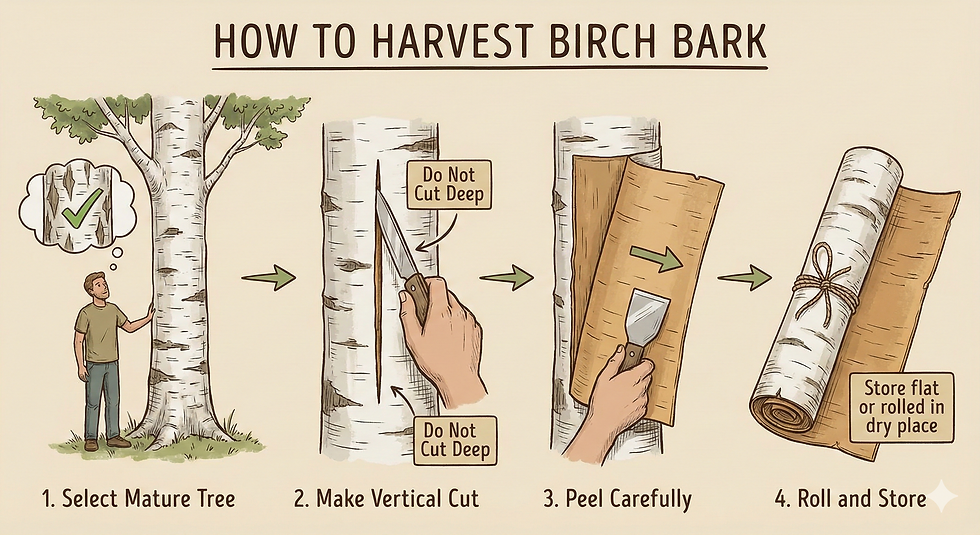
Paper Birch Bark (Betula papyrifera): The "skin" of the canoe. Chosen for its unique properties: it is strong, flexible, water-resistant, and resistant to rot. The grain wraps around the tree, allowing large, continuous sheets to be peeled without killing the tree if done correctly.
Cedar Wood (Thuja occidentalis): Used for the internal frame, ribs, and planking. Cedar is prized for being extremely light, straight-grained, and easy to split and steam-bend into shape.
Spruce Roots (Watap): The "thread" that held the canoe together. Long, tough, and flexible roots from black or white spruce trees were harvested, split, and used to stitch the sheets of bark together and lash the bark to the frame.
Spruce or Pine Gum: The sealant. Tree resin was collected, heated, and mixed with animal fat and charcoal to create a waterproof pitch applied over all seams and stitching holes, making the canoe watertight.
Ingenuity of Construction

Building a birchbark canoe was a complex process that required the specialized skills of a master builder, often involving the entire community. It began with finding and carefully peeling large, flawless sheets of bark from mature birch trees in the spring or early summer.
A building bed was prepared on level ground, and the bark sheets were laid out and held in place with stakes and heavy stones to form the bottom and sides. A framework of cedar gunwales was assembled, and the bark was folded up and stitched to it using the split spruce roots. The characteristic shape of the canoe—with its upswept bow and stern—was formed.
The true genius of the design lay in its internal structure. Thin cedar sheathing was slipped between the bark and the frame to protect the bark. Then, pre-bent cedar ribs were hammered into place, forcing the canoe into its final, taut shape. This tension-based construction created an incredibly resilient hull that could flex slightly to absorb the shock of waves or rocks without breaking. Finally, every seam and stitch was meticulously sealed with the heated spruce gum mixture.
Traditional Use and Impact
The birchbark canoe was the undisputed workhorse of the north. Its impact on Indigenous life was profound.
Transportation and Travel: It provided a fast and efficient means of travel across a landscape dominated by water. Families could move between seasonal camps, hunters could access distant territories, and messengers could travel rapidly between communities.
Trade Networks: The canoe enabled the creation of extensive trade routes spanning thousands of miles. Goods like copper, furs, shells, and sacred stones were transported far from their sources, connecting distant tribes economically and culturally.
Hunting and Fishing: The canoe provided a stable and silent platform for fishing on lakes and rivers and for hunting waterfowl. Its shallow draft allowed it to navigate small streams and marshes inaccessible to larger craft.
Legacy and Modern Connection
The arrival of Europeans did not make the birchbark canoe obsolete; on the contrary, it became essential to the fur trade. Indigenous guides and builders supplied the technology that opened up the interior of the continent to explorers and traders. The famous "voyageur" canoes, some upwards of 30 or 40 feet long and carrying tons of cargo, were simply scaled-up versions of the traditional design.
Today, the art of building birchbark canoes is kept alive by a small number of dedicated Indigenous artisans and non-Indigenous enthusiasts. Each canoe built is a testament to the enduring legacy of this remarkable technology. Modern recreational canoes made of aluminum, fiberglass, and Kevlar are direct descendants of the birchbark original, borrowing its proven hull shape and design principles. The wiigwaasi-jiimaan remains a powerful symbol of Indigenous ingenuity, resilience, and a deep, abiding relationship with the natural world.
Discover how the Wiigwaasi-Jiimaan building tradition is being preserved in Northern Minnesota today


Comments